Claude Mythos 5.1:research, capabilities, and trusted access
An independent guide to Claude Mythos 5.1: research examples, safeguards, and the official approval pathways. This is not a public LAYSO API access offer.
Access & scope
claude-mythos-5-1
This article does not grant eligibility or confirm API availability on LAYSO.
What is Claude Mythos 5.1?
Claude Mythos 5.1 is Anthropic’s vetted-access offering for advanced cybersecurity and life-sciences work. Fable 5.1 uses the same underlying model with additional domain safeguards. Mythos is not an unrestricted public alternative. Source: official Mythos page.
This article focuses on research evidence, access conditions, and deployment questions. For general coding and knowledge-work API integration, use the Claude Fable 5.1 guide. Keeping these use cases separate prevents a research demonstration from becoming an unsupported promise about a public API.
LAYSO availability: this is an informational guide. It does not announce a Mythos route, sell access, or grant eligibility for Anthropic’s programs.
Mythos 5.1 research: molecular design and GPU optimization
Anthropic reports that Mythos 5.1 produced protein-binder designs with external laboratory validation, reaching an aggregate hit rate near 50% across twelve targets. It also reports optimization of seven scientific models, with speedups up to 2.5× and estimated genome-analysis GPU savings of 30–60%. Source: research examples.
Molecular-design evidence
The official poster below illustrates one target from the study. Its displayed target-specific rate should not be substituted for the aggregate result. A predicted structure, a binding result, and a clinically useful treatment are different stages of evidence. This article provides no experimental protocol and makes no clinical efficacy claim.
For a research review, ask which outputs were computational predictions, which were tested externally, and what the comparison baseline measured. Keep attribution to the specific model and study conditions.
Computational performance
A model-level speedup and the saving on a complete analysis are different measurements. Before carrying a reported result into your own infrastructure budget, check hardware, batch size, numerical agreement, setup overhead, and whether intermediate outputs can be reused.
LAYSO’s evaluation advice is to reproduce a small, authorized workload against a fixed baseline and retain both timing and correctness checks. Do not interpret “up to” as an expected gain on every scientific model.
The Venus terrain-mapping example belongs to Fable 5.1. See its science section for that separate case.
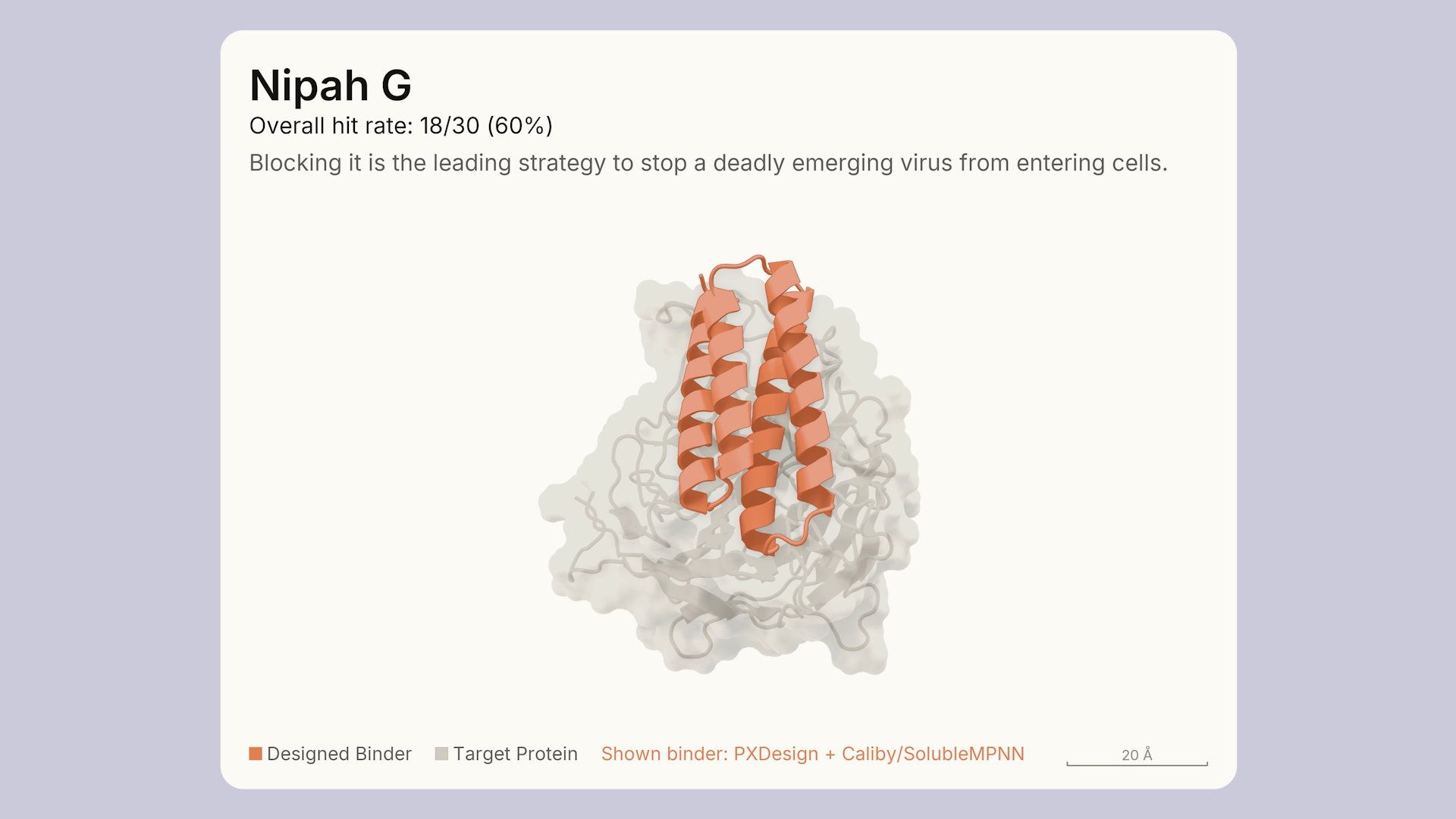
Official video poster: one target-specific example, not the aggregate hit rate across the study.
How to read Mythos 5.1 benchmark results
The official comparison identifies 60.9% for Mythos 5.1 on Terminal-Bench 4.0, separately from Fable 5.1’s result. Most other rows are labeled Fable. Do not turn that table into a complete Mythos leaderboard. Publisher comparison.
The Fable benchmark section includes the original image and evaluation caveats. Model identity alone is not the full test configuration: filters, fallbacks, tool harnesses, task versions, and effort settings can all change what a score represents.
For an internal evaluation, label every result with the actual access configuration used. Report completion quality, failed runs, reviewer corrections, and cost together. Keep restricted research tests separate from routine development tasks rather than collapsing both into one ranking.
Claude Mythos 5.1 trusted access and availability
Anthropic describes an invite-only Life Sciences Verification Program and a Cyber Verification Program whose Mythos expansion is planned. At announcement, access is limited to selected US organizations, with broader availability being pursued. Claude Security also uses Mythos 5.1. Official availability.
Cybersecurity pathway
Consult the Cyber Verification Program for the current application process. An application is not an approval, and participation does not authorize work against systems you do not own or have permission to assess.
Life-sciences pathway
Use Anthropic’s official access information to confirm eligibility and enrollment. Prepare a clear description of the proposed work, accountable reviewers, institutional controls, and how outputs will be evaluated.
What a gateway account does not provide
A LAYSO key is not a substitute for program approval. This page intentionally has no Mythos API sample, playground, or “buy access” control. If your task is ordinary software development or document analysis, evaluate the separately documented Fable API route.
Mythos 5.1 pricing, data retention, and safety
Anthropic’s model page lists starting rates of $10 per million input tokens and $50 per million output tokens, with 30-day safety-monitoring retention by default. These are provider references for eligible access, not a LAYSO quote. Source: Mythos pricing and retention.
Ask the provider to confirm applicable terms, regional availability, limits, and any additional charges before budgeting. Do not assume Fable’s cache terms or a different product’s privacy arrangement automatically apply to a Mythos program.
Governance remains necessary
Vetted access is not equivalent to removing all safeguards. Define who can initiate a run, what data the environment may contain, which tools it can call, and which actions need approval. Store audit evidence without exposing sensitive research or credentials unnecessarily.
A useful safety review includes malicious content embedded in retrieved documents, attempted actions outside the approved task, and recovery from tool failures. Keep these checks within an authorized test environment. A strong model benchmark does not replace least-privilege access, isolation, or human oversight.
A practical checklist for approved research teams
- Confirm the access grant. Record the eligible organization, permitted use, provider terms, and responsible reviewers.
- Define the claim being tested. Separate hypothesis generation, analysis, experimental evidence, and operational deployment.
- Freeze a baseline. Save model configuration, data version, tool versions, and acceptance criteria.
- Measure complete workflows. Count failed attempts, review effort, and full-run cost rather than selecting the best isolated result.
- Review outputs independently. Reproduce important calculations and route consequential findings to the relevant domain experts.
- Stage deployment. Start with constrained, reversible tasks; widen permissions only after review.
This is LAYSO’s editorial checklist, not Anthropic’s enrollment criteria. It is intended to help teams ask better questions before adopting a research system.
For the primary evidence and current terms, read the joint announcement, Mythos model page, and system card. For broader-access integration, continue with Claude Fable 5.1.
Claude Mythos 5.1 FAQ
Can I call Mythos 5.1 through LAYSO now?
This page does not offer or confirm a Mythos route on LAYSO. Do not treat a LAYSO account or API key as approval for Anthropic’s trusted-access programs.
Are all published Fable 5.1 scores also Mythos scores?
No. Keep each result attached to the model label and evaluation conditions shown by Anthropic. A shared underlying model does not justify relabeling the entire benchmark table.
Is Mythos 5.1 an unrestricted model?
No. Access is vetted and the relevant program adjusts specific safeguards. Approval does not remove all safety requirements or grant permission for arbitrary tasks.
Which guide should a general API developer read?
Start with the Claude Fable 5.1 guide for ordinary coding and knowledge-work integration. Consult the Mythos guide when your approved research needs the separate trusted-access pathway.